

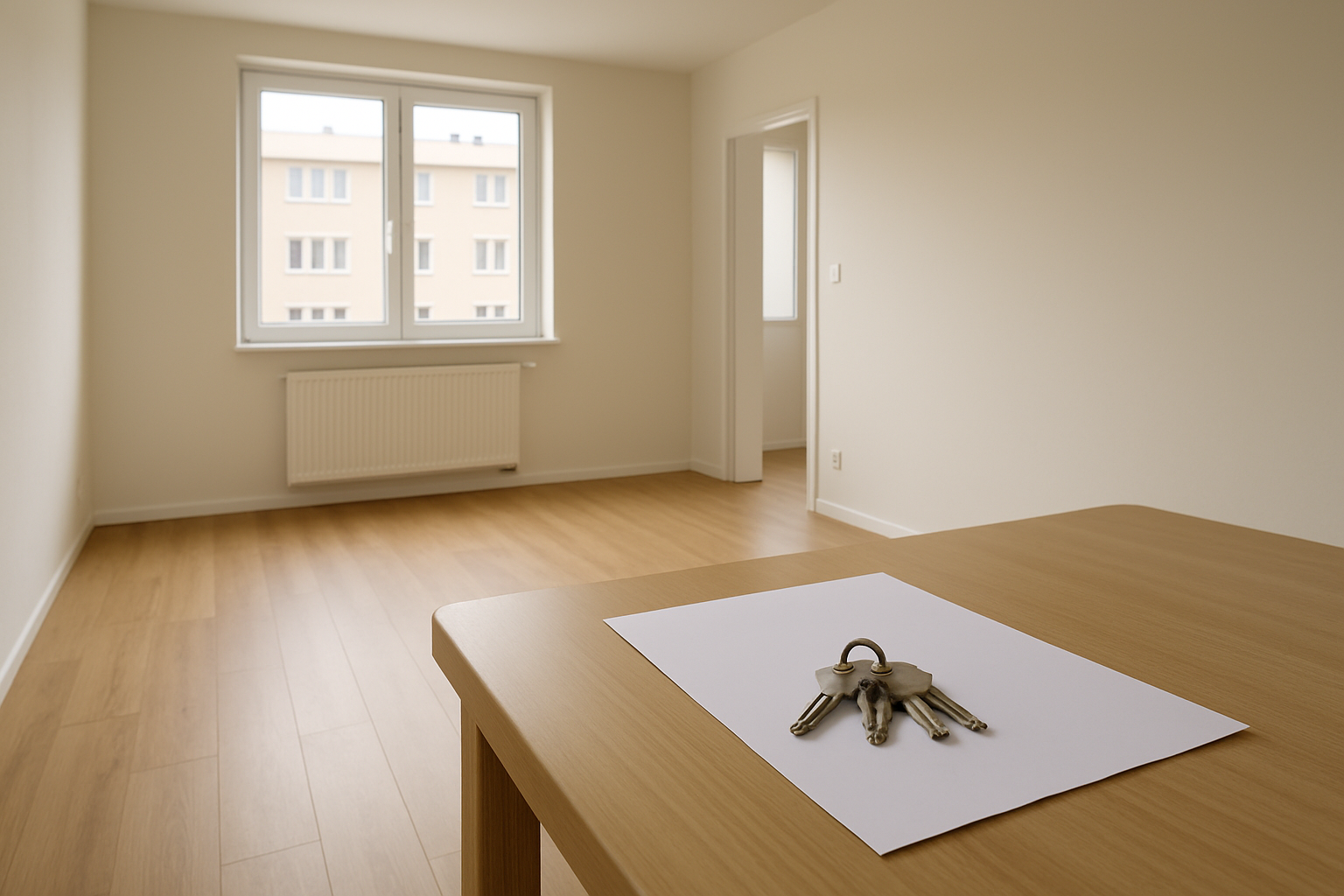
It is advisable to start dealing with the security deposit before handing over the apartment. This gives you time to check the documents, take any missing photographs, remove your belongings and agree with the landlord on how the final condition will be recorded.
First, read the tenancy agreement, the original handover record and any individual agreements with the landlord. Pay particular attention to the conditions for ending the tenancy, the agreed handover process, information about the security deposit and any obligations relating to cleaning, furnishings or payments. The specific circumstances and wording of your agreement may be decisive, so it is not possible to specify one universal process or deadline for every tenancy.
Which documents and confirmations to prepare
Gather the documents in one place, ideally both electronically and in an easily accessible paper format. The following may be particularly useful:
- the tenancy agreement and its amendments,
- proof that the security deposit was paid,
- the original handover record and inventory of furnishings,
- photographs or videos from the time you moved in,
- written agreements concerning repairs, alterations or replacement of equipment,
- confirmations of rent and other payments relevant to the settlement,
- communications concerning reported faults and how they were addressed,
- documents relating to repairs or services that you arranged in agreement with the landlord,
- meter readings and the number of keys received.
A document by itself may not determine the outcome of the settlement. However, it helps create a timeline and clarify what was agreed, paid or reported.
How to compare the apartment’s original and final condition
Work through the apartment room by room and use the same order as in the original handover record. Compare specific elements: walls, floors, doors, windows, sanitary fixtures, kitchen equipment, furniture and appliances.
If you have photographs from when you moved in, try to repeat the shots from a similar position and in similar lighting. New photographs should show both the overall view and details of any defect. Keep them in their original quality and do not delete the creation date information if it is available.
For each difference, briefly state:
- where it is located,
- what it looked like at the start of the tenancy according to the available records,
- what condition it is in at handover,
- whether it was previously reported,
- whether a repair was carried out or a further course of action was agreed.
Normal wear and tear and damage
Normal wear and tear arises from the gradual use of items, while damage may be associated with a specific event or improper handling. However, the distinction between them may not always be clear.
The assessment depends on the actual condition, the duration and manner of use, the age of the equipment, the agreement and the available documentation. Therefore, avoid categorical conclusions based on a single photograph. Instead, describe the disputed item accurately and record the position of both parties.
How to record furnishings, meters and keys
Create a joint record at handover. For furnishings, state the name of each item, the number of pieces and its visible condition. If possible, check the basic operation of appliances in the presence of both parties. Do not carry out dangerous work or specialist tests yourself.
For meters, record the date, time, meter identification if legible and the displayed reading. Photograph the reading so that the display or dial is visible while also making it clear which meter it is.
For keys, record the number and type of items handed over, such as keys for the apartment, building entrance, cellar or mailbox, or a remote control. Also state whether all copies known to both parties have been returned.
What the handover confirmation should contain
The written confirmation should also be clear to someone who was not present at the handover. It is practical to include:
- identification of the apartment and the contracting parties,
- the date and time of handover,
- the condition of individual rooms and furnishings,
- identified defects or differing positions,
- meter readings,
- a list and the number of keys handed over,
- information about attachments and photographs provided,
- the agreed method of further communication,
- outstanding items that still need to be checked,
- confirmation from both parties that they received the record.
If you disagree about something, the dispute does not have to be resolved at the door. Both positions can be recorded objectively in the document without either party automatically agreeing with the other party’s view.
How to request an explanation of deductions from the security deposit
If the landlord proposes a deduction, ask for an itemised and understandable explanation. For each item, it should be clear what it concerns, what condition was identified and which supporting information the proposed amount is based on.
In particular, you may ask for:
- a description of the specific defect or unpaid item,
- identification of the relevant part of the agreement or arrangement if the deduction is based on it,
- photographs or a record of the condition,
- an explanation of how the amount was determined,
- a copy of a relevant document if it already exists and the landlord refers to it,
- separation of undisputed and disputed items.
This does not mean that every dispute can be resolved solely by a document or photograph. The objective is for both parties to understand what the settlement is based on and precisely where they disagree.
What to do if the original handover record or photographs are missing
Missing original documentation makes comparison more difficult, but you can still gather other supporting materials. Search emails, messages, cloud storage and older photographs in which the apartment may have been captured indirectly.
Communications about defects, service records, an inventory in the agreement or messages sent shortly after moving in may be useful. Ask the landlord whether they have their own copy of the handover record or photographs.
Document the final condition as accurately as possible even if you have nothing with which to compare it. State openly that the original condition is not sufficiently documented. Do not create backdated documents or present an estimate as a confirmed fact.
How to communicate when there is disagreement
Focus on specific items, dates and documents. Instead of judging the other party’s intentions, describe which point you disagree with and why. Confirm important arrangements in writing.
- Identify the disputed item.
- State which supporting materials you have available.
- Ask the other party for their supporting materials.
- Propose a specific next step, such as a joint inspection or additional details in the settlement.
- Express your position calmly and without personal attacks.
If the situation is legally unclear, a significant amount is disputed or the parties cannot agree on the next step, it is advisable to contact a qualified professional. They can assess the specific agreement, documentation and circumstances of the case.
Checklist for the final week of the tenancy
- Check the agreement, amendments and agreed handover conditions.
- Find proof of the security deposit, the original handover record and older photographs.
- Gather payment confirmations and communications concerning repairs.
- Arrange a date for the joint handover.
- Inspect the apartment room by room and record its condition.
- Photograph furnishings, any defects and meter readings.
- Count the keys and other means of access.
- Remove personal belongings and fulfil the agreed obligations.
- Prepare a draft handover record.
- Agree on how and where the security deposit settlement will be delivered.
Template for a neutral message to the landlord
Hello, the tenancy of the apartment at [address] is approaching its end. Please suggest a date for a joint handover so that we can record the condition of the apartment, furnishings, meters and returned keys.
I would also like to ask what documents you will need for the security deposit settlement and how we will confirm the next steps. If you propose any deductions, please provide an itemised explanation and identify the supporting information on which they are based.
The following dates are suitable for me: [dates]. Thank you for confirming.
This text is only a practical communication template. Sending it does not in itself replace the terms of the agreement or an individual arrangement between the tenant and the landlord.
Frequently asked questions
Does the tenant have to sign everything at handover?
Before signing, read the document and check whether it accurately reflects what happened during the handover. If you disagree with a point, ask for your position to be recorded. The specific consequences of signing depend on the content of the document and the circumstances.
Are photographs sufficient without a written handover record?
Photographs are useful, but they may not capture every relevant circumstance. A combination of photographs, a written record, meter readings and confirmation of the keys is usually the clearest approach.
What if the amount of a deduction is unclear?
Ask for an itemised breakdown, a description of the identified condition and an explanation of the calculation. Then compare the response with the agreement and your own supporting materials. If the uncertainty remains, consider obtaining professional advice on the specific case.
Do all items have to be resolved on the day of handover?
Some information may not be available at that time. It is important to record in writing what remains outstanding, who is to provide the supporting information and how the parties will continue to communicate. The precise process depends on their agreement and the tenancy agreement.